

Basic Electric Guitar Circuits 2: Potentiometers & Tone Capacitors
Part 2: Potentiometers and Tone Capacitors
What is a Potentiometer?
Potentiometers, or "pots" for short, are used for volume and tone control in electric guitars. They allow us to alter the electrical resistance in a circuit at the turn of a knob.
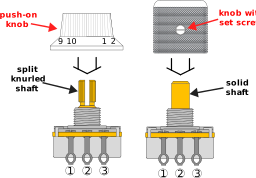
Drawing of physical potentiometers depicting terminals 1, 2, and 3
Drawing of potentiometer schematic depicting terminals 1, 2, and 3

It is useful to know the fundamental relationship between voltage, current and resistance known as Ohm's Law when understanding how electric guitar circuits work. The guitar pickups provide the voltage and current source, while the potentiometers provide the resistance. From Ohm's Law we can see how increasing resistance decreases the flow of current through a circuit, while decreasing the resistance increases the current flow. If two circuit paths are provided from a common voltage source, more current will flow through the path of least resistance.
Ohm's Law
$$V = I \times R$$where ~V~ = voltage, ~I~ = current and ~R~ = resistance
V = IR diagram

Basic Electric Guitar Circuit
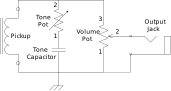
Alternative functional terminal names
| Terminal 1 | "Cold" |
| Terminal 2 | "Wiper" |
| Terminal 3 | "Hot" |
A Visual Representation of how a potentiometer works
Based on a 300 degree rotation
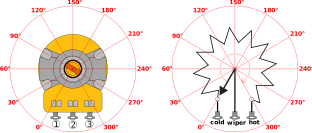
We can visualize the operation of a potentiometer from the drawing above. Imagine a resistive track connected from terminal 1 to 3 of the pot. Terminal 2 is connected to a wiper that sweeps along the resistive track when the potentiometer shaft is rotated from 0° to 300°. This changes the resistance from terminals 1 to 2 and 2 to 3 simultaneously, while the resistance from terminal 1 to 3 remains the same. As the resistance from terminal 1 to 2 increases, the resistance from terminal 2 to 3 decreases, and vice-versa.
Tone Control: Variable Resistors & Tone Capacitors
Tone pots are connected using only terminals 1 and 2 for use as a variable resistor whose resistance increases with a clockwise shaft rotation. The tone pot works in conjunction with the tone capacitor ("cap") to serve as an adjustable high frequency drain for the signal produced by the pickups.
Tone Circuit
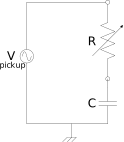
The tone pot's resistance is the same for all signal frequencies; however, the capacitor has AC impedance which varies depending on both the signal frequency and the value of capacitance as shown in the equation below.
$$\text{Capacitor Impedance} = Z_{\text{capacitor}} = \frac{1}{2 \pi f C}$$where ~f~ = frequency and ~C~ = capacitance
Capacitor impedance decreases if capacitance or frequency increases.High frequencies see less impedance from the same capacitor than low frequencies. The table below shows impedance calculations for three of the most common tone cap values at a low frequency (100 Hz) and a high frequency (5 kHz)
| ~C~ (Capacitance) | ƒ (Frequency) | ~Z~ (Impedance) |
|---|---|---|
| .022 μF | 100 Hz | 72.3 kΩ |
| .022 μF | 5 kHz | 1.45 kΩ |
| .047 μF | 100 Hz | 33.9 kΩ |
| .047 μF | 5 kHz | 677 Ω |
| .10 μF | 100 Hz | 15.9 kΩ |
| .10 μF | 5 kHz | 318 Ω |
When the tone pot is set to its maximum resistance (e.g. 250kΩ), all of the frequencies (low and high) have a relatively high path of resistance to ground. As we reduce the resistance of the tone pot to 0Ω, the impedance of the capacitor has more of an impact and we gradually lose more high frequencies to ground through the tone circuit. If we use a higher value capacitor, we lose more high frequencies and get a darker, fatter sound than if we use a lower value.
Volume Control: Variable Voltage Dividers
Volume pots are connected using all three terminals in a way that provides a variable voltage divider for the signal from the pickups. The voltage produced by the pickups (input voltage) is connected between the volume pot terminals 1 and 3, while the guitar\'s output jack (output voltage) is connected between terminals 1 and 2.
Voltage divider equation:
$$V_{\text{out}} = V_{\text{in}} \times \frac{R_2}{R_1 + R_2}$$From the voltage divider equation we can see that if ~R_1 = 0\text{Ω}~ and ~R_2 = 250\text{kΩ}~, then the output voltage will be equal to the input voltage (full volume).
$$V_{\text{out}} = V_{\text{in}} \times \frac{250\text{kΩ}}{0 + 250\text{kΩ}} = V_{\text{in}} \times \frac{250\text{kΩ}}{250\text{kΩ}}$$$$V_{\text{out}} = V_{\text{in}}$$If ~R_1 = 250\text{kΩ}~ and ~R_2 = 0\text{Ω}~, then the output voltage will be zero (no sound).
$$V_{\text{out}} = V_{\text{in}} \times \frac{0}{250\text{kΩ} + 0} = V_{\text{in}} \times \frac{0}{250\text{kΩ}}$$$$V_{\text{out}} = 0$$Two Resistor Voltage Divider Schematic
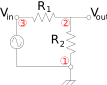
Example:
$$V_{\text{in}} = 60\text{mV} \text{, } R_1 = 125\text{kΩ} \text{, } R_2 = 125\text{kΩ}$$$$V_{\text{out}} = V_{\text{in}} \times \frac{R_1}{(R_1 + R_2)}$$$$V_{\text{out}} = 60\text{mV} \times \frac{125\text{kΩ}}{(125\text{kΩ} + 125\text{kΩ})}$$$$V_{\text{out}} = 60\text{mV} \times \frac{1}{2}$$$$V_{\text{out}} = 30\text{mV}$$Potentiometer Taper
The taper of a potentiometer indicates how the output to input voltage ratio will change with respect to the shaft rotation. The two taper curves below are examples of the two most common guitar pot tapers as they would be seen on a manufacturer data sheet. The rotational travel refers to turning the potentiometer shaft clockwise from 0° to 300° as in the previous visual representation drawing.

How do you know when to use an audio or linear taper potentiometer?
The type of potentiometer you should use will depend on the type of circuit you are designing for. Typically, for audio circuits the audio taper potentiometer is used. This is because the audio taper potentiometer functions on a logarithmic scale, which is the scale in which the human ear percieves sound. Even though the taper chart appears to have a sudden increase in volume as the rotation increases, in fact the perception of the sound increase will occur on a gradual scale. The linear scale will actually (counterintuitively) have a more significant sudden volume swell effect because of how the human ear perceives the scale. However, linear potentiometers are often used for other functions in audio circuits which do not directly affect audio output. In the end, both types of potentiometers will give you the same range of output (from 0 to full), but the rate at which that range changes varies between the two.
How do you know what value of potentiometer to use?
The actual value of the pot itself does not affect the input to output voltage ratio, but it does alter the peak frequency of the pickup. If you want a brighter sound from your pickups, use a pot with a larger total resistance. If you want a darker sound, use a smaller total resistance. In general, 250kΩ pots are used with single-coil pickups and 500kΩ pots are used with humbucking pickups.
Specialized Pots
Potentiometers are used in all types of electronic products so it is a good idea to look for potentiometers specifically designed to be used in electric guitars. If you do a lot of volume swells, you will want to make sure the rotational torque of the shaft feels good to you and most pots designed specifically for guitar will have taken this into account. When you start looking for guitar specific pots, you will also find specialty pots like push-pull pots, no-load pots and blend pots which are all great for getting creative and customizing your guitar once you understand how basic electric guitar circuits work.